
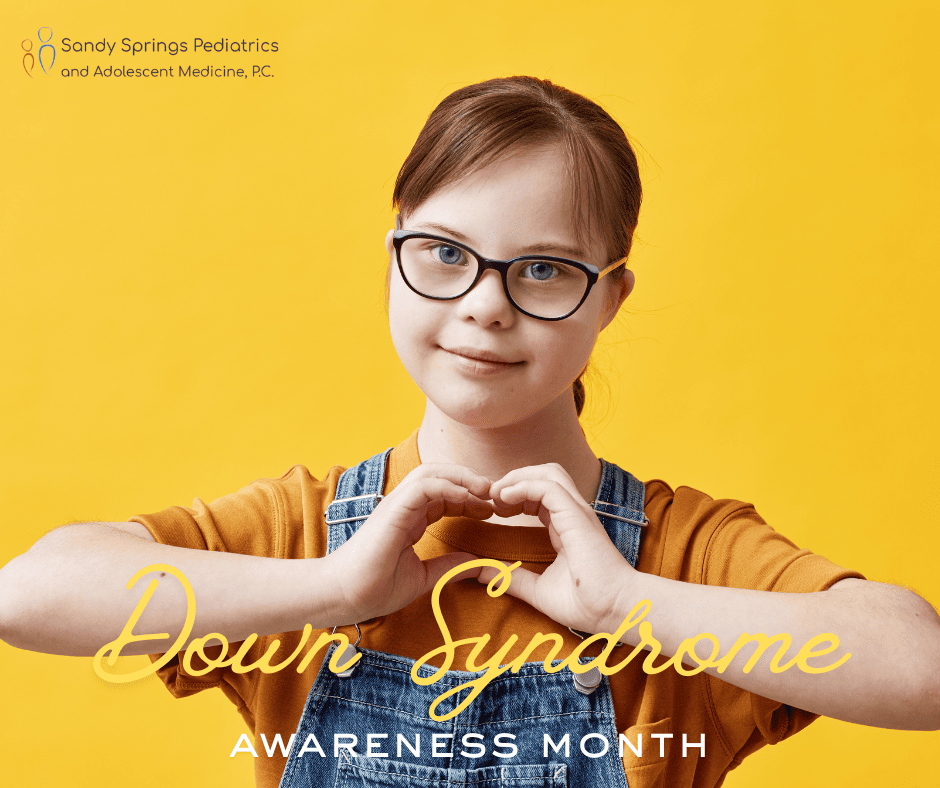
Every October, Down Syndrome Awareness Month invites families, schools, and communities to pause, reflect, and uplift children and adults with Down syndrome—celebrating their unique abilities, affirming their worth, and equipping parents and caregivers with confidence for the journey ahead.
If you’ve recently learned that your child has Down syndrome, that news may have left you with a swirl of emotions—surprise, uncertainty, even loss of the expected path. It’s normal. At Sandy Springs Pediatrics, we want you to know you’re not alone. Research-informed pediatric and psychology advice show that early, intentional steps help families build resilience, connection, realistic hope, and thriving outcomes. Here’s your comprehensive guide to how you can navigate this with love, strategy, and empowerment.
What It Means—and What To Focus On
Down syndrome is a genetic condition caused by an extra copy of chromosome 21. The diagnosis comes with unique medical, developmental, and support-needs, but it also comes with a vast spectrum of possibility, joy, and potential.
Rather than dwelling solely on “what will be different,” shifting the lens to “what can be possible”, adjusting expectations—but not lowering them—is a powerful mindset. Children with Down syndrome attend school, build friendships, learn jobs, participate actively in community life, and bring gifts and value to their families and peers.
As psychologists emphasize, cultivating a family culture of acceptance, optimism, and realistic goal-setting lays the groundwork for emotional health—for your child and your entire family.
For Parents: Navigating the early days with strength
When the diagnosis is new, many parents ask: “What do I say? What do I do first?” Here are essential suggestions rooted in developmental-psychological best practice:
- 1. Allow yourself the full spectrum of feelings.
You may feel relief (in knowing), sadness (for a different expected path), uncertainty, even guilt. These are normal—what matters is acknowledging them and giving yourself gentle permission to experience them rather than suppress them. - 2. Get accurate information early from trustworthy sources.
Your child’s pediatric provider can refer you to specialty clinics—such as the Emory Down Syndrome Clinic in Atlanta, which provides multidisciplinary evaluation and guidance for children with Down syndrome. Reliable information helps reduce anxiety and counter “worst‐case scenario” fears. - 3. Build your support network now.
Joining local organizations—such as the Down Syndrome Association of Atlanta (DSAA) and GiGi’s Playhouse Atlanta—provides emotional connection, practical resources, and examples of individuals thriving with Down syndrome.
You’ll find other parents, siblings, professionals and self-advocates who have walked this path and whose stories can bring hope. - 4. Begin early intervention and therapy planning.
Developmental research shows that early, consistent intervention—speech, occupational, physical therapy—helps children with Down syndrome gain stronger outcomes in communication, motor skills, social participation and learning. Your pediatrician can refer you, and many programs are available in Georgia.
Starting early doesn’t mean “fixing” your child—it means giving them the supports they need to flourish. - 5. Set realistic goals—but aim high.
“Realistic” means personalized, not generic. For example: “We’ll work on letting our child attempt to feed himself with minimal help by age 2” or “We’ll help her join a peer playgroup by half-year.” These incremental milestones give you and your child measurable progress, and the long-term vision remains: independent living, community participation, fulfilling relationships. - 6. Care for your emotional and relational well-being.
Studies show that families who develop resilience—through peer support, therapy if needed, and good self-care—are better equipped to navigate the ups and downs of raising a child with additional needs. Don’t wait to ask for help if you find yourself feeling overwhelmed, isolated, or grieving.
Encouraging Your Child’s Development and Celebrating Ability
From the psychology of child development and the lived lived-experience of individuals with Down syndrome, a few key principles stand out: strength-based focus, growth mindset, inclusion and community participation.
- Focus on what your child can do. Notice their personality, preferences, sensibilities, humor, heart. These are often the strongest predictors of how your child will thrive.
- Create a rich, stimulating home environment. Language-rich conversations, shared reading, playful movement, sibling interaction—all matter. Children with Down syndrome benefit from enriched, responsive homes.
- Encourage peer interaction and inclusive education. Social competence grows when children are included with typical peers, have opportunities to contribute, and experience success in multiple settings (school, play, church, community).
- Teach self-advocacy and self-confidence over time. As your child enters school and adolescence, emphasis on communication, decision-making, expressing wants/needs, and social connection becomes essential.
- Celebrate each milestone and re-envision “success.” Whether it’s smiling at a friend, saying “help,” participating in a family game, getting dressed independently—each step is meaningful. Success is not only about major milestones—it’s about ongoing growth.
Practical Considerations: Health, Education & Planning
Children with Down syndrome may face distinct medical and developmental considerations. Being proactive matters.
- Medical screenings and coordination. Many clinics—including the Emory Down Syndrome Clinic—provide a roadmap of screenings, developmental check-ins and specialty referrals (cardiology, ENT, audiology, thyroid, sleep, etc.).
- Educational planning. Early childhood programs and special education services in Georgia (Birth–5 through “Babies Can’t Wait,” and then IEP services when age-eligible) are key. DSAA provides educational resource directories.
- Long-term planning. Conversations about transition to adulthood, independence, future employment or vocational experiences, supported living or community participation begin earlier than many families expect. Local resources in Georgia are available for adults with Down syndrome.
Local resources you should bookmark
Here are some Atlanta-area organizations and services ready to support you:
- Down Syndrome Association of Atlanta (DSAA) – Connects families, hosts events, training, advocacy, new-parent support. (Down Syndrome Association of Atlanta)
- GiGi’s Playhouse Atlanta – Free educational, therapeutic, and social-skills programs for individuals with Down syndrome and their families. (gigisplayhouse.org)
- Emory Down Syndrome Clinic – Specialized multidisciplinary medical care, developmental evaluation, and referral coordination. (med.emory.edu)
- Georgia Department of Behavioral Health & Developmental Disabilities (DBHDD) – Family Support Services – Helps families access information, respite, and supports for children with developmental disabilities—including Down syndrome. (dbhdd.georgia.gov)
Final Thoughts: You’re Not Just Caring—You’re Nurturing Potential
Receiving a diagnosis of Down syndrome is a life-changing moment—but it’s not the end of a story, it’s the beginning of a new kind of story. One rich with relationships, growth, connection, possibility and hope.
As you walk this path with your child, embrace the following truths:
- You are your child’s advocate, first and strongest. Your voice, love, and belief matter immensely.
- Every child with Down syndrome is a unique individual. Their path will be theirs. Avoid comparing with others; measure progress by them.
- Support makes the difference. Early intervention, inclusive environments, strong psychosocial and family support all tilt outcomes upward.
- Joy, connection, meaning matter most. A fulfilling life isn’t defined only by milestones—it’s defined by belonging, purpose, laughter, and relationships.
- The community around you is stronger than you think. Use the organizations above. Reach out. Connect. Ask questions. Share triumphs and challenges.
At Sandy Springs Pediatrics, we’re honored to partner with you and your child—whether as a newborn, toddler, or school-aged child—with medical care, developmental monitoring, and family-centered guidance. Please reach out, schedule conversations, and know our practice stands ready to support your family in this journey.