
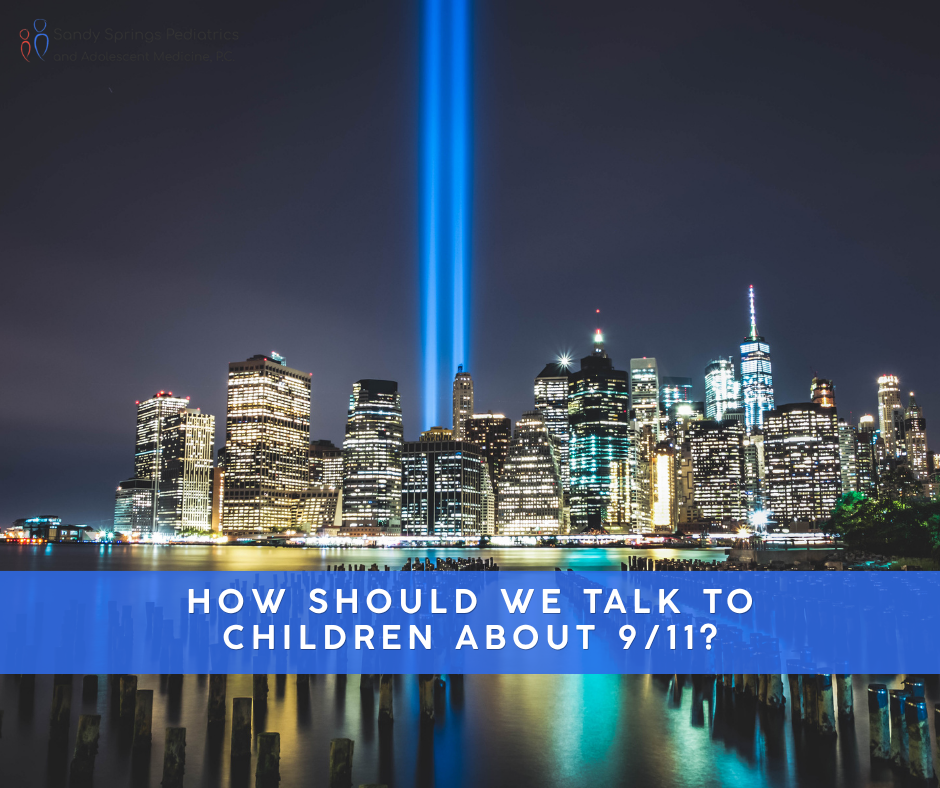
For adults who remember September 11, 2001, the date may bring back unusually vivid memories: where they were, who told them and how it felt to watch the day unfold. Children growing up today experience 9/11 differently. To them, it is history—yet the images, language and emotions surrounding the anniversary can still feel immediate and frightening.
Leading pediatric and child-mental-health organizations recommend an approach built on honesty, age-appropriate detail, attentive listening and limited exposure to graphic media. The goal is not to tell children every painful detail. It is to help them understand what happened at a level they can manage, correct misinformation and give them a safe place to ask questions.
Begin by finding out what your child already knows
Before offering an explanation, ask:
“What have you heard about September 11?”
“What questions do you have?”
“Is there anything about it that worries you?”
The American Academy of Pediatrics recommends beginning with what a child has already heard and keeping the discussion direct and straightforward. This allows parents to identify misunderstandings without providing more information than the child needs.
Some children will want to talk extensively, while others may have little interest. Both responses can be normal. The National September 11 Memorial & Museum advises adults not to force the conversation but to remain available if questions arise later.
Use clear and accurate language
Children benefit from simple, truthful explanations. A basic factual description might be:
“On September 11, 2001, members of a terrorist organization hijacked four airplanes. Two were flown into the World Trade Center towers in New York City, one was flown into the Pentagon, and the fourth crashed in Pennsylvania after passengers and crew members fought back. Nearly 3,000 people were killed. Firefighters, police officers, medical professionals and many other people responded to help.”
The amount of detail included should depend on the child’s age, prior knowledge and emotional readiness.
Avoid euphemisms that may create confusion, particularly when explaining death. It is generally clearer to say that people “died” than to say they “went to sleep” or “went away.” Graphic descriptions are not necessary for children to understand the event’s historical importance.
Babies and toddlers: Protect their environment
Babies and toddlers cannot understand the history of 9/11, but they can respond to changes in an adult’s voice, facial expression and stress level.
There is no developmental need to explain the attacks to a child this young. Instead, protect them from television coverage, distressing audio and graphic images. Maintain familiar routines involving meals, naps, bedtime and play. If a parent becomes emotional while remembering the day, it is appropriate to acknowledge the emotion simply: “I am feeling sad right now, but I am safe, and you are safe with me.”
Preschoolers, approximately ages 3–5: Keep it brief and concrete
Preschoolers may hear the words “9/11” at school, from older siblings or through media without understanding that the attacks occurred many years ago. Young children may also believe that repeated footage shows a new event happening each time it plays.
If a preschooler has not heard about 9/11 and is unlikely to encounter the subject, a detailed introduction may not be necessary. If the child asks, provide a brief answer:
“A long time ago, some people hurt many other people on purpose. A lot of helpers came to rescue and care for people. Today, we remember everyone who died and everyone who helped.”
Answer the question asked, then pause. The child may be satisfied with a short explanation. Avoid showing footage of the attacks, the towers collapsing or people in immediate danger.
Young children sometimes communicate distress through behavior rather than words. Increased clinginess, sleep disruption, separation difficulty, irritability or regression in previously learned skills can occur when children feel frightened or overwhelmed.
Early elementary school, approximately ages 6–8: Give the basic facts
Children in early elementary school can understand that 9/11 was a real historical event, although their understanding of time, death and national security is still developing.
Begin by asking what they have learned. Correct inaccuracies calmly and provide the central facts without graphic detail. For example:
“On September 11, 2001, terrorists took control of four airplanes and used them to attack the United States. Many people died. First responders and ordinary people showed great courage by helping others.”
Children this age may ask whether another attack will happen or whether their family is safe. Avoid making absolute promises that nothing bad can ever happen. A more accurate reassurance is:
“Events like this are rare. Many people work every day to protect communities and respond to emergencies. The adults in your life will continue doing everything they can to keep you safe.”
Allow children to move between serious conversation and ordinary play. Returning to normal activities does not mean they are unaffected or unconcerned.
Older elementary school, approximately ages 9–11: Add context gradually
Older elementary students can usually understand a fuller sequence of events and may ask why the attacks occurred. They may also encounter dramatic videos, inaccurate claims or disturbing details online.
Provide information in stages rather than attempting to explain the entire history in one conversation. Explain that terrorism involves using violence or the threat of violence to frighten people and pursue political or ideological goals. Make clear that the terrorists responsible for 9/11 do not represent an entire religion, nationality, ethnic group or culture.
This age group may benefit from verified educational resources, maps, timelines and age-appropriate accounts of survivors and first responders. Parents should preview material before sharing it, because resources about 9/11 can contain graphic images or descriptions.
Questions about blame, fairness and safety are common. Listen for the concern beneath the question. A child asking, “Could someone fly a plane into my school?” may be seeking reassurance more than a detailed explanation of aviation security.
Tweens, approximately ages 11–13: Discuss history and media literacy
Tweens can engage with greater historical complexity but may still have difficulty judging the reliability or emotional impact of online content.
Ask what they have seen on social media, in class or among friends. Review the source together. Explain the difference between primary sources, verified historical records, commentary and unsupported claims. Repeated exposure to graphic footage is not required for learning and may increase distress.
Tweens may be ready to discuss the effects of 9/11 on national security, military action, public policy and American Muslim communities. These conversations should distinguish clearly between the individuals and organization responsible for the attacks and the broader groups that were subjected to suspicion, discrimination or violence afterward.
Encourage questions without expecting the child to reach an immediate conclusion. Complex historical events often require more than one conversation.
Teenagers: Invite analysis without assuming emotional distance
Teenagers can generally understand the attacks, their historical background and their long-term consequences. They may examine terrorism, war, civil liberties, prejudice, national security, first-responder health and the ways societies memorialize tragedy.
Invite them to evaluate evidence and compare reliable sources. Ask:
“What have you learned that surprised you?”
“How do you decide whether a source about 9/11 is trustworthy?”
“What do you think remembering this day should look like for your generation?”
Do not assume that a teenager who appears detached is unaffected. Some teens process difficult information privately or express discomfort through humor, irritability or avoidance. Others may feel deeply connected to a family member’s experience, military service, cultural identity or memories passed down through the family.
Correct misinformation without humiliating the teen. If the discussion becomes emotionally charged, pause and return to it later.
Limit repeated and graphic media exposure at every age
The American Academy of Child and Adolescent Psychiatry, the American Academy of Pediatrics and the National Institute of Mental Health all advise limiting children’s exposure to repetitive, violent or distressing coverage of traumatic events.
Parents should preview documentaries, museum materials, social-media posts and classroom resources whenever possible. Even older children may be disturbed by recordings of final phone calls, images of people falling, footage of the towers collapsing or detailed descriptions of deaths.
Watching together allows an adult to provide context, notice the child’s response and stop the material if necessary.
Let children see remembrance as more than tragedy
Children can learn the history of 9/11 while also learning about courage, service, compassion and community response. Age-appropriate stories may focus on first responders, medical teams, search-and-rescue dogs, blood donors, volunteers, survivors and people who supported grieving families.
This emphasis should not replace the facts or minimize the loss of life. It provides a fuller account of how people responded and shows children that acts of violence were met by organized rescue efforts and widespread care for others.
Families might observe a moment of silence, visit a memorial, write a note of appreciation to a first responder, participate in a service project or learn about one person whose life was lost. These activities can give remembrance a concrete and meaningful form.
Know when a child may need additional support
Temporary sadness, worry or questions can be normal after learning about a traumatic event. Consider contacting your child’s pediatrician or a qualified mental-health professional when symptoms are intense, persist or interfere with daily life.
Signs that may warrant additional support include ongoing sleep problems, frequent nightmares, persistent physical complaints, significant separation anxiety, avoidance of school, repeated intrusive thoughts, marked changes in behavior or mood, loss of interest in usual activities, declining school functioning or continuing fear that the family is in immediate danger.
Children with personal histories of trauma, anxiety, bereavement, military deployment or family connections to 9/11 may need additional care and a more individualized approach.
Remembering with honesty and care
There is no perfect script for explaining September 11. The most appropriate conversation is shaped by the child’s age, development, existing knowledge, personal experiences and questions.
Parents do not need to have every answer. It is both honest and reassuring to say, “I don’t know, but we can look for a reliable answer together.”
As we remember the lives lost and the courage shown on September 11, we also help the next generation understand why this day continues to hold such meaning. Children do not need every painful detail to learn its history. They need accurate information, thoughtful guidance and an adult who is willing to listen.
Sandy Springs Pediatrics is here to support families with concerns about a child’s emotional health, anxiety, sleep, behavior or response to distressing events.